E Ink technology
How e-paper works
Not a dimmer LCD. Not OLED in beige. Charged pigment in a capsule, a voltage, and an image that holds itself after the power stops. Everything else — color, ghosting, “video” — is a footnote on that sentence.
01
A capsule, not a crystal
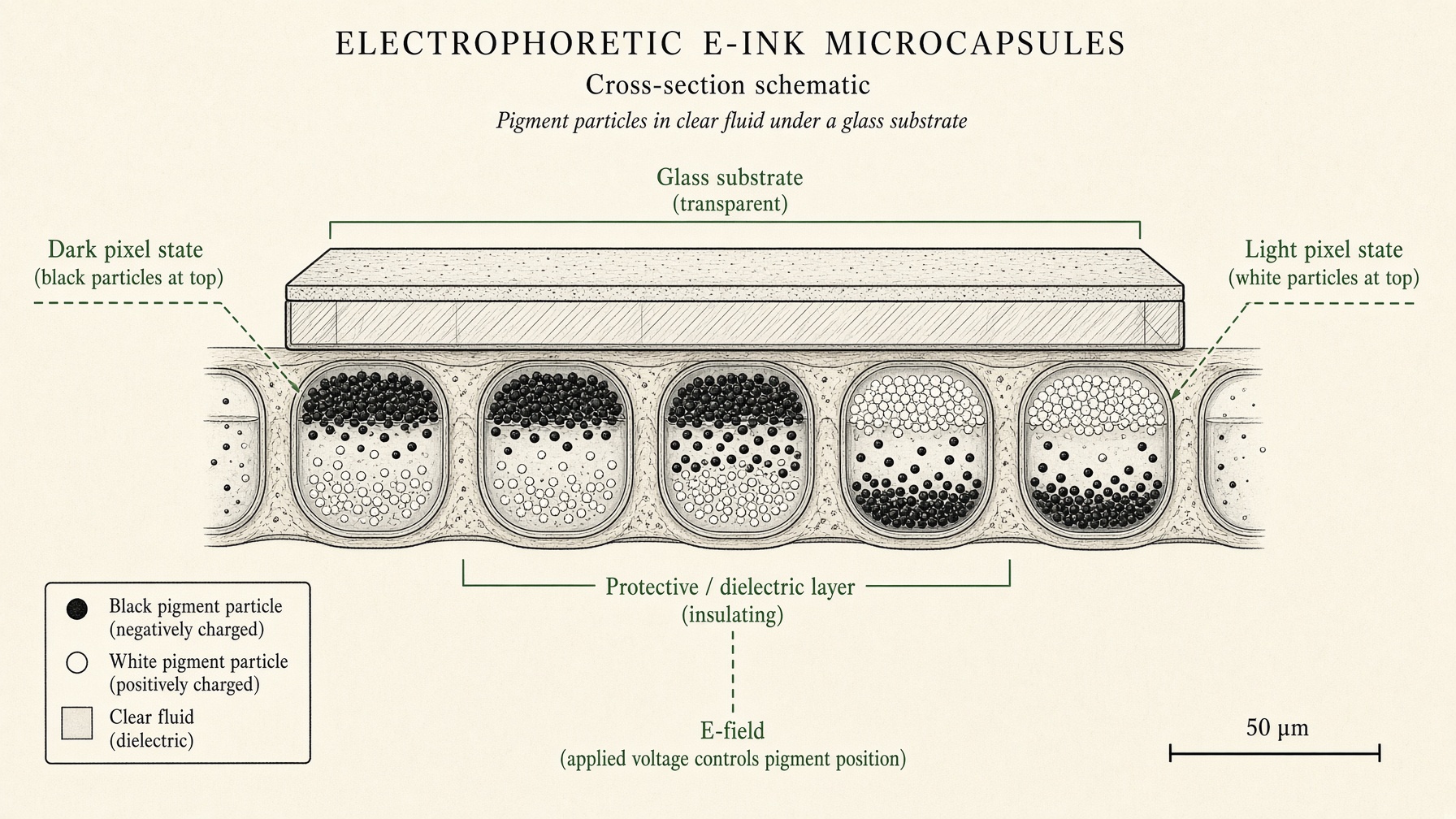
Each pixel is a microcapsule of fluid holding charged white and black pigment. A voltage on the thin-film transistor pulls one species to the top. The other hides. No backlight is required — ambient light reflects off the white particles, the way paper does.
02
Bistable: it stays
Once the pigment has moved, it stays without holding a voltage. That is why a Kindle can hold a page for weeks on a charge, and why a shelf label can show a price for years on a coin cell. OLED cannot do this. LCD mostly cannot.
03
Waveforms, not frames
Updating a page is a packed sequence of voltages called a waveform. GC16 paints a clean grayscale image slowly. A2 and DU cheat: fewer gray levels, faster motion, more ghosting. Every serious e-paper device is a waveform manager pretending to be a tablet.
04
Ghosting is physics
Pigment does not always finish the trip. A faint previous page lingers until a full refresh flashes the screen. Fast modes make this worse on purpose. It is not a defect so much as a receipt.
Interactive demo
Flip the pigment
Each circle is a microcapsule. Positive voltage draws white pigment to the glass; negative draws black. GC16 is a full grayscale refresh.
A short history of the page
1997–2007
Origins
MIT Media Lab work and the founding of E Ink Corporation. Microcapsules of charged black and white pigment in a clear fluid, addressed by a TFT backplane.
2007
Vizplex / Kindle
The first Kindle ships. Electrophoretic paper leaves the lab and becomes a store. Contrast is modest. The idea is not.
2010
Pearl
Higher contrast, faster updates. Kindles and Nooks of the early 2010s live here.
2013–2018
Carta
The modern paper look. Carta generations lift contrast and cut the milky gray. 300 ppi becomes the reading default.
2021–2023
Carta 1200 / 1300
Faster waveforms, deeper blacks. Carta 1300 is the 2026 black-and-white reference in phones, readers, and 25-inch desks.
2016–2023
Color: Triton to Kaleido 3
Filter-based color. Kaleido 3 reaches ~4096 colors, 150 ppi color / 300 ppi ink, and 30% more saturation than Kaleido Plus.
2023–
Gallery 3 & Spectra 6
Pigment color, not a filter. Gallery 3 for notebooks; Spectra 6 for retail posters and shelf labels with print-like gamut and slow refresh.
Four ways to make it color
“Color e-ink” is not one product. Filter, pigment, and signage chemistry get sold under the same sentence. They should not be.
The reference black-and-white panel. Best contrast, best text, no filter tax.
- Colors
- 16 gray levels
- Speed
- Fast (for e-paper)
- Resolution
- Up to 300 in readers
- Use
- Novels, code, phones, 25-inch desks
A printed comic on newsprint. Fast enough to live with. Grainy up close. Darker than Carta.
- Colors
- ~4,096
- Speed
- Near-Carta with extra ghosting
- Resolution
- 300 ink / ~150 color
- Use
- Readers, notes, color phones
Real pigment in the pixel. Color looks printed. Page turns take a breath. Not for video.
- Colors
- Tens of thousands
- Speed
- Slow
- Resolution
- ~229–300 full color
- Use
- Notebooks, art, marked diagrams
Designed to hold a campaign for days, not to scroll a feed. The highest-volume color e-paper.
- Colors
- Wide, saturated, print-like
- Speed
- Slowest
- Resolution
- Signage distances
- Use
- Posters, ESLs, transit
What it is not
Is e-paper better for your eyes?
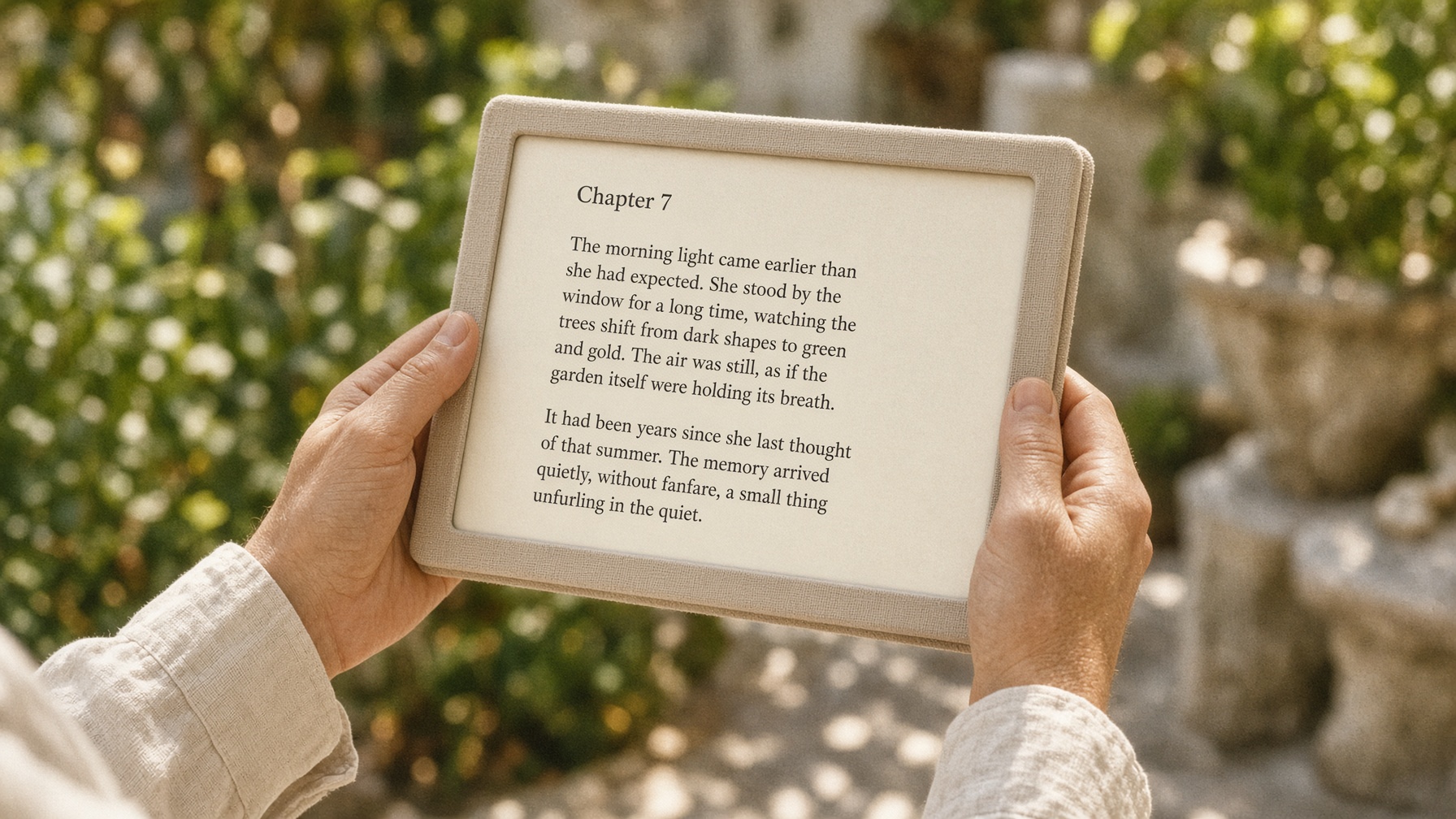
It is easier on eyes for long text because it is reflective and stable, not because of a medical miracle. It does not flicker like a badly tuned PWM OLED. It also does not replace outdoor time or a lamp at night. Front lights still emit, including some blue, though ComfortGaze tunes the spectrum.
Can it do video?
Poorly, on purpose. Fast waveforms (A2) can fake 10–15 fps gray video with heavy ghosting. Kaleido 3 can show a clip. You will not watch a film. Signage color cannot.
Why is it expensive?
Yields on large electrophoretic films, a single supplier ecosystem (E Ink Holdings, Taiwan), and tiny volumes relative to LCD. A 25-inch Carta desk is a handmade object pretending to be consumer electronics.
Is NXTPAPER or Daylight ‘e-ink’?
No. They are reflective or hybrid LCDs. Excellent at some of the same jobs (sunlight, less glow). Different physics. We file them under adjacent technology.